Australian mining company Aldoro Resources has entered into a memorandum of understanding with WILLETECH International Investment, a move that could bring up to N$7 billion into the development of Namibia’s Kameelburg Critical Minerals Project. The agreement marks a pivotal shift in the project's corporate structure, moving it from an exploration-focused entity toward commercial production capabilities.
Under the terms of the proposed partnership, WILLETECH is set to acquire a controlling 51% stake in the project through the subscription of new shares in Kameelburg Exploration Mining (Pty) Ltd. This acquisition would dilute existing holdings, with Aldoro Resources retaining a 42% interest. Namibian shareholders, who currently hold 15% of the project company, would see their stake reduced to 7% under the new arrangement.
Aldoro clarified that the investment commitment is non-binding at this stage. The funds are intended to be deployed in phases, contingent upon the conclusion of definitive agreements and the achievement of specific project milestones. The parties have set a target to finalize these definitive agreements within 15 business days.
Funding Mechanisms and Regulatory Hurdles
WILLETECH aims to secure development funding of at least RMB 2 billion, which translates to approximately A$429.1 million or N$7 billion. This capital is designated to finance the project’s development, construction, and transition to commercial production. The investment will also cover technical, engineering, market, and industrial resources as agreed upon by the parties.
As a first step, WILLETECH intends to make an initial funding amount of RMB 100 million available. Aldoro confirmed that this initial tranche has already been placed in a supervised account in China. However, the transfer of these funds to Namibia is subject to China’s outbound investment approval process.
The transaction faces several regulatory gates before it can proceed. It remains subject to definitive agreements, shareholder approval, applicable Namibian regulatory approvals, and the aforementioned Chinese outbound investment clearances. The partners are also exploring the possibility of listing the project on the Hong Kong Stock Exchange in the future to support long-term financing.
Strategic Value and Project Resources
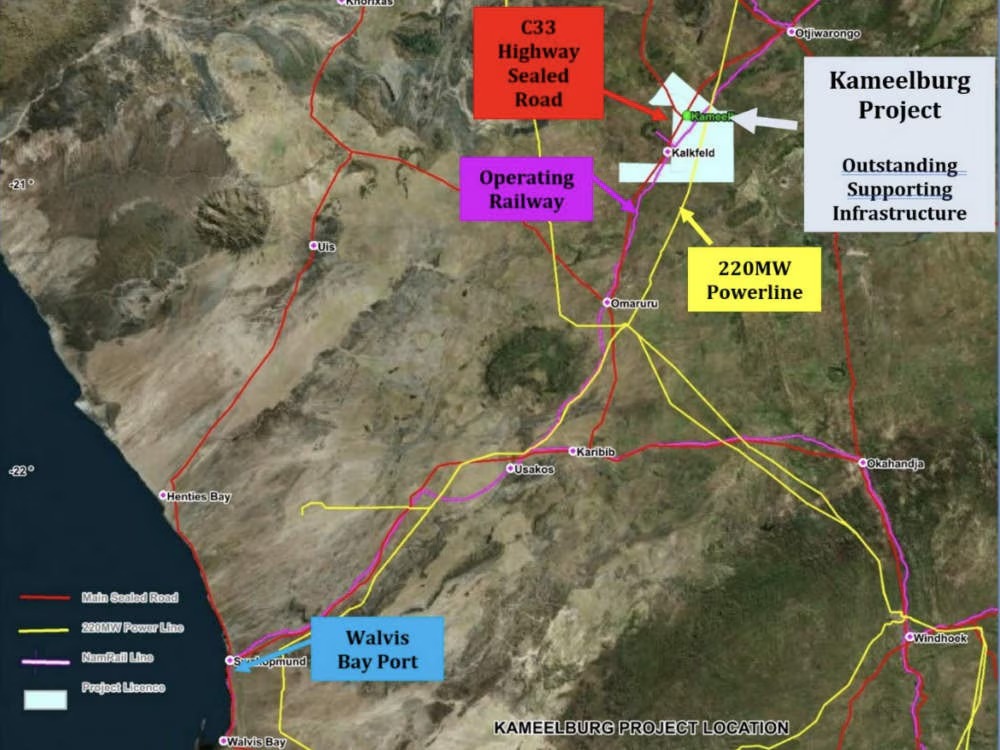
The Kameelburg project, located within exploration licence EPL 7373, is significant for its deposits of rare earth elements, strontium, and niobium. These minerals are critical components in electric vehicles, wind turbines, industrial motors, and other advanced technologies. According to Aldoro’s mineral resource estimate from August 2026, the site hosts approximately 804.5 million tonnes of mineral resources. This includes an estimated 1.37 million tonnes of neodymium-praseodymium (NdPr) oxides.
Aldoro Executive Chair Quinn Li described the partnership as a major milestone in the company's evolution. He highlighted that WILLETECH’s expertise in German materials technology, Singapore’s international trade networks, and China’s manufacturing capabilities would be instrumental in advancing the project.
Local stakeholders have also expressed support for the development. Namibian director and local partner King Frans Indongo Jr. welcomed the investment, emphasizing the potential for sustainable development. He stated that the partners would work to create employment and skills opportunities for Namibians while delivering lasting benefits to local communities.
Key Financial and Structural Details
The following points outline the core financial and structural elements of the proposed deal:
- WILLETECH International Investment will acquire a 51% stake in Kameelburg Exploration Mining (Pty) Ltd.
- Aldoro Resources will retain a 42% interest in the project company following the share subscription.
- Namibian shareholders will hold a reduced 7% stake, down from their current 15% position.
- The total potential investment is valued at N$7 billion, with an initial RMB 100 million tranche secured in a Chinese supervised account.
- The project contains an estimated 1.37 million tonnes of neodymium-praseodymium oxides within 804.5 million tonnes of mineral resources.